Preface: When a “Blank Market” Meets “Precision Manufacturing”
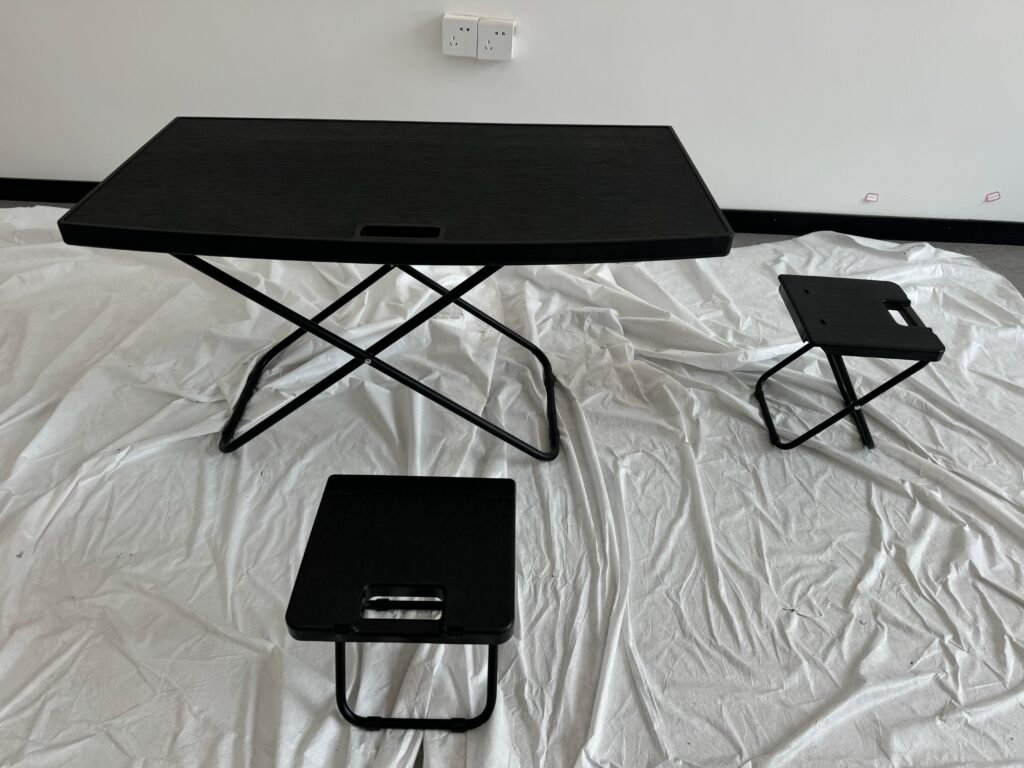
A revolutionary demand is surging through the automotive modification world. With the global rise of Tesla and Electric Vehicles (EV), a unique opportunity has emerged: because battery EVs no longer require spare tires, a large, rectangular hidden cavity — the Sub-trunk — has appeared beneath the rear cargo floor.
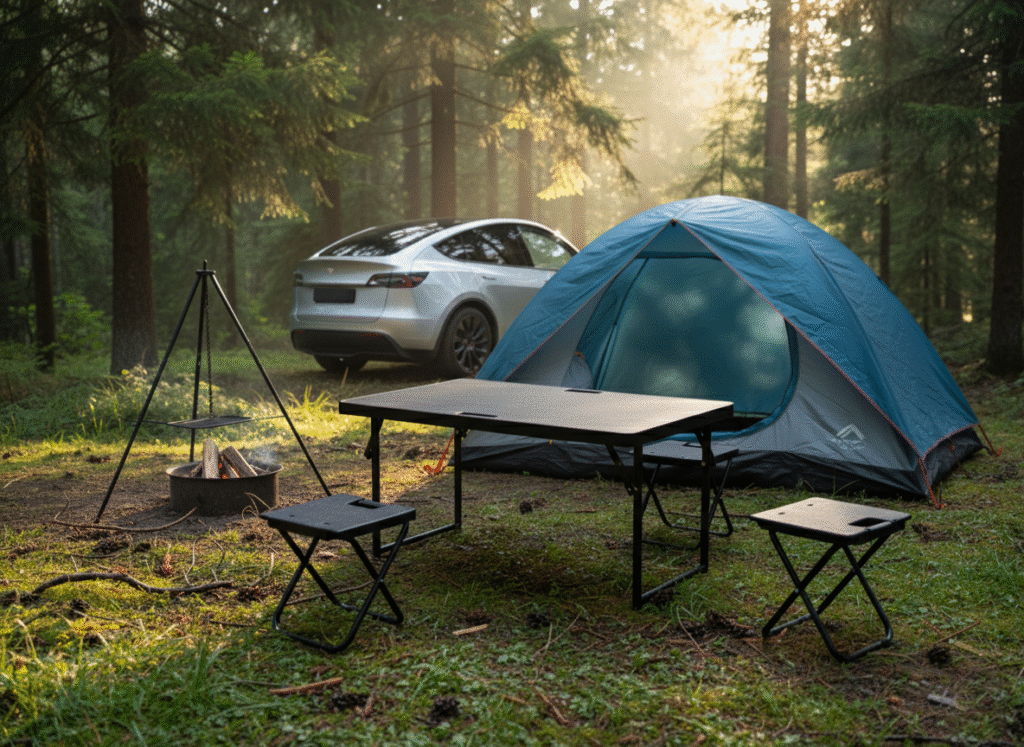
A group of passionate young car owners challenged us with a demanding request:
“Can you develop a table that remains completely invisible when stored, but transforms into a sophisticated coffee station with stools when deployed? And can you do it fast enough to keep up with Tesla’s rapid release cycles?”
As a factory with decades of experience in metal and plastic composite furniture, we realized this wasn’t just a product request — it was an extreme stress test for our supply chain.
Phase 1: Deep Dialogue — Finding the Product’s Soul in User Needs
During early development, our design team engaged in intensive brainstorming with these young enthusiasts. The logic of the product was forged in these key Q&A sessions:
Q: There are plenty of folding tables on the market. Why not use those?
“They take up too much space! EV owners crave minimalism. Traditional tables are 8–10 cm thick when folded. If we put that in the sub-trunk, the floor panel won’t close flush. That ‘imperfection’ is unacceptable.”
Q: You want extreme space efficiency, but also want 2–4 stools tucked inside. How is that possible?
“That’s what we need the factory to solve. We need a ‘1+N’ system — the table is the carrier, and the stools are modules. Furthermore, the development cost must be low because new car models iterate so fast.”
Phase 2: The Strategy — Avoiding the “Injection Molding Trap” for “Blow Molding Agility”
Faced with these requirements, our R&D team made a strategic decision: pivot from injection molding to blow molding.
Challenge: The High Cost and Slow Pace of Injection Molding
Initially, we considered injection molding. However, the molds are incredibly expensive and the development cycle typically lasts over 2 months. For a modification market requiring 15 new products a year, injection molding was simply too slow and too expensive.
Breakthrough: The Triple Advantage of Blow Molding
| Advantage | Details |
|---|---|
| Cost & Speed | Blow molding tool costs are only 1/3 of injection molding, and the cycle is more than halved — giving us the freedom to develop dedicated molds for every specific car model |
| Structural Superiority | Blow-molded parts are double-layered and hollow, providing natural cushioning and high load-bearing capacity while being lighter than solid plastic — perfect for the lightweighting goals of EVs |
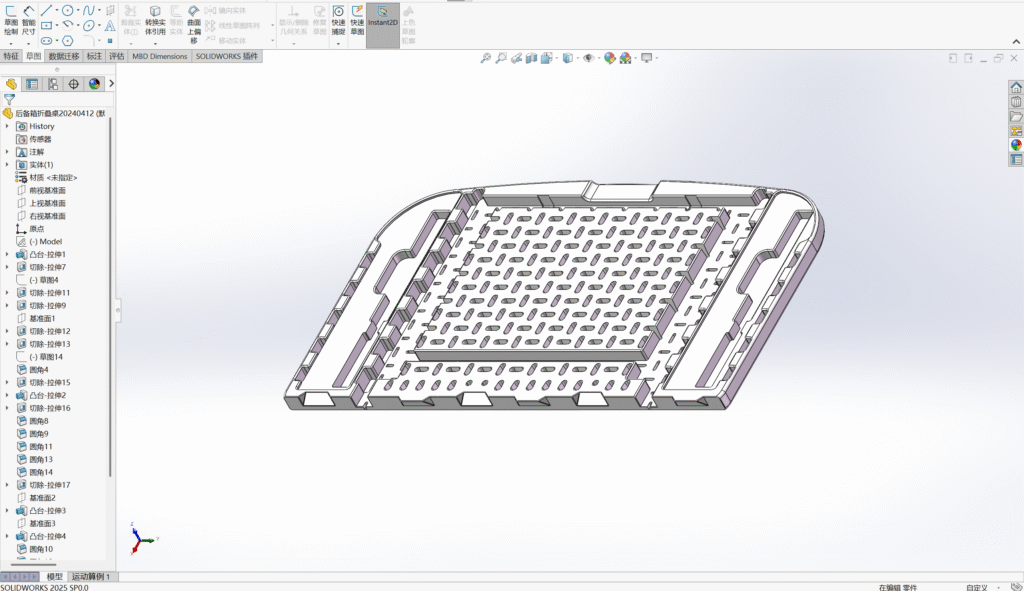
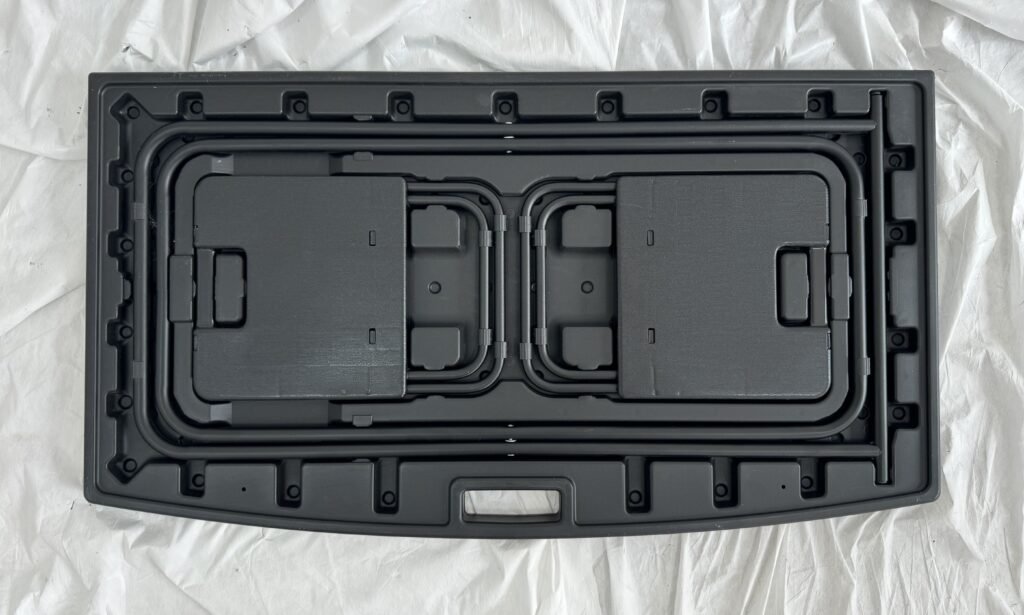
| Space Optimization | By leveraging our in-house design expertise, we engineered precise recesses within the tabletop’s underside. Using our established metal tube forming technology, we created ultra-flat folding stool frames that snap perfectly into these recesses like puzzle pieces |
Solving the “Driving Noise” Issue
Quiet EV cabins amplify every rattle. We utilized our full-chain assembly advantage to integrate custom rubber dampening at every metal-to-plastic contact point. By ensuring every component fits with zero tolerance, we achieved a “Zero-Rattle” out-of-the-box experience.
Phase 3: Speed is the Lifeline — The “40-Day Law”
After our first success, the demand intensified: “We need to sync with every new EV launch worldwide.”
To achieve this, we established a Blow-Molding-Based Agile R&D Process:
| Timeline | Phase | Activity |
|---|---|---|
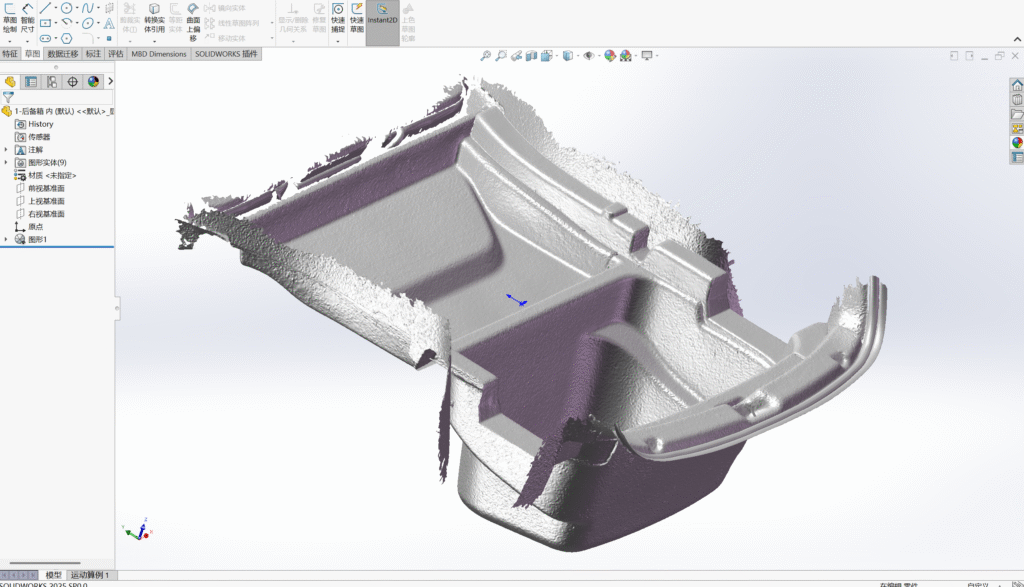
| Day 1–2 | 3D Scanning | Complete sub-trunk data collection on the day of a new car launch |
| Day 3–10 | CAD Design | Rapidly match new dimensions with our existing metal frame library |
| Day 11–25 | Tooling | Fast-track blow-mold manufacturing and prototype testing |
| Day 40 | Mass Production | While the blow-mold is finalized, metal frames are already produced, powder-coated, and ready for final assembly and shipping |
The Result: Within one year, we developed 15 dedicated products for models ranging from the entire Tesla fleet to all other EVs in the market — transforming a traditional factory into a “Fast-Fashion Center” for the automotive world.
Conclusion: From a Blank Market to a Million-Dollar Success
This case study reveals the “Breakthrough Formula” for traditional manufacturing in a changing trade landscape:
- The Thesis: Can a traditional factory handle the hyper-personalized demands of the new generation?
- The Proof: Yes — by combining the flexibility of Blow Molding, the maturity of Metal Forming, and the responsiveness of Agile Design.
- The Outcome: In just one year, we achieved over $1,000,000 in sales in the previously non-existent “EV Sub-trunk table” category. Today, 90% of the products in this category online originate from our factory. Others may copy us, but we control the rhythm of innovation.
To Our Global Partners
On our site, you see more than just products — you see a Product Proposal Center with full manufacturing control.
Whether you are a Tesla modifier or an innovator in pet or senior care, we use the most efficient processes to help you capture your “Blue Ocean.”
-01-300x300.jpg)